



Just register for the free trial below and we will send you everything you need to evaluate QuickBooks Online including 30-day access, the full 76-page QuickBooks Online Guide (details everything that you can do in the software) plus the video training library. Free end-to-end consultation and support are included so if you need any help along the way, just let us know!


This guide walks through setting up QuickBooks Online multicurrency from start to finish, with updated 2026 interface screenshots for activation, currency settings, foreign currency customers, invoicing, and exchange rate management. If you sell or buy across borders, enabling multicurrency in QuickBooks Online lets you record foreign currency transactions, send international invoices, and track currency gains and losses without juggling spreadsheets.
Businesses dealing with international customers, suppliers, or global operations require an accounting software that offers multi-currency support. QuickBooks Online offers a powerful multicurrency feature that helps businesses accurately capture, process, and convert transactions in various currencies.
In this article, we’ll discuss multicurrency in QuickBooks, how to set it up, plus some advanced tips and strategies to better manage multiple currencies using the software.
What is multicurrency in QuickBooks?
Multicurrency in QuickBooks Online is a feature that allows businesses to perform financial transactions, record expenses, and create reports using different currencies. With this feature enabled, QuickBooks Online can automatically convert amounts from one currency to another based on the prevailing exchange rates, streamlining the process of managing transactions involving international customers, suppliers, or operations across various currencies.
Turn on Multicurrency in QuickBooks
To use the multicurrency feature in QuickBooks Online, you need to turn it on first. To do this, click on the cog wheel icon and then select Account and settings. Click on Advanced in the left navigation bar and then select the Currency section. Click Edit, and then from the Home Currency dropdown, choose your currency. Click Save to proceed.
Note that once multicurrency is turned on, you won’t be able to turn it off anymore.
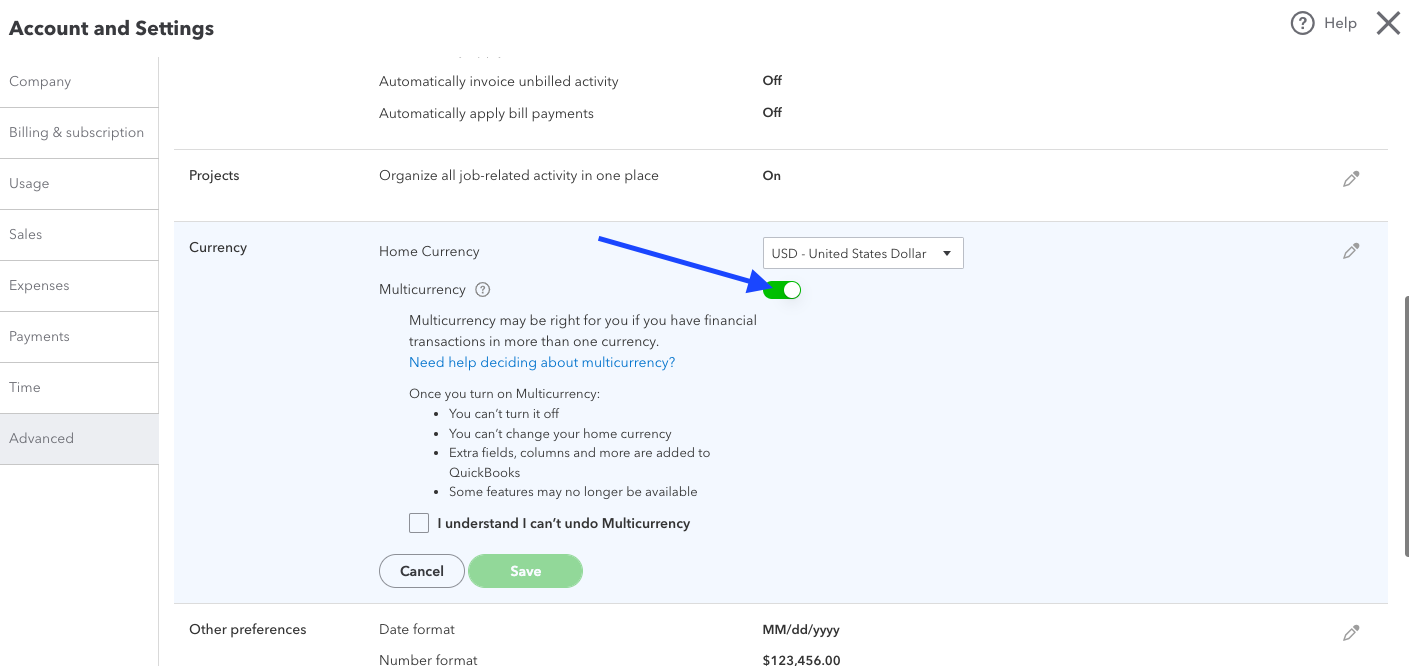
Once the multicurrency feature is turned on, QuickBooks display a Manage Currencies link which will take you to a screen you can manage all the currencies your business use.
Turning on the multi-currency feature in QuickBooks Online
The QuickBooks Online multicurrency activation screen, found under Account and settings > Advanced > Currency (2026 interface).

The currency selection settings page where you choose your home currency before enabling multicurrency in QuickBooks Online.
Adding a New Currency
To add a new currency, click on the cog wheel icon and then select Currencies. Note that this will only appear when the multicurrency feature is turned on. Click the Add currency button, and then from the Add currency dropdown, find the currency you wish to add.
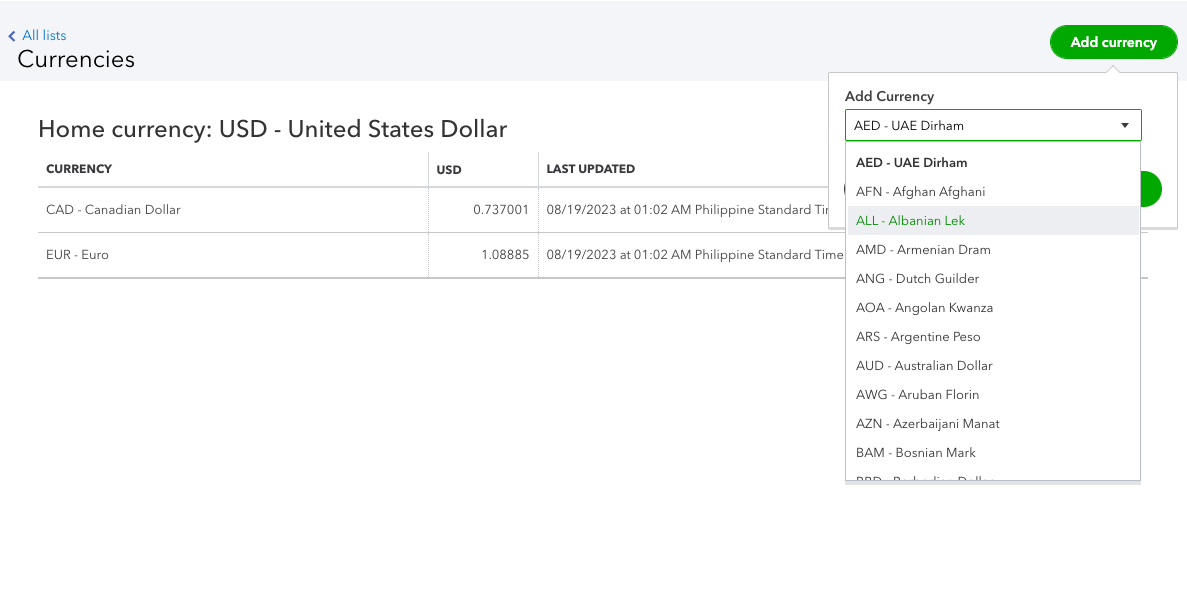
Managing multicurrencies in QuickBooks Online

A customer profile in QuickBooks Online with a foreign currency assigned. Each customer or vendor can be tied to one currency, which then carries through to their invoices and bills.
Using the Multicurrency Feature
You can use the multicurrency feature in QuickBooks in different ways, such as adding an account that uses a foreign currency, entering transactions in a foreign currency, and using exchange rates on foreign currency invoices. Additionally, you can deposit a payment to a bank using foreign currencies.
When entering transactions such as invoices, bills, or expenses, you can now select the appropriate currency for each transaction. QuickBooks Online will automatically convert the amount to your reporting currency using the prevailing exchange rate. QuickBooks Online updates exchange rates automatically but allows manual adjustments if needed. Regularly review and update exchange rates to ensure accurate conversions. For historical transactions, use the exchange rate at the time of the transaction.

Creating a foreign currency invoice in QuickBooks Online. When you pick a customer assigned to a foreign currency, the invoice switches to that currency and shows the exchange rate used for international invoicing.

The exchange rate adjustment screen. QuickBooks Online pulls rates automatically, but you can override a rate on any transaction for accurate currency conversion and foreign currency reporting.
When reconciling bank transactions, ensure the correct currency is assigned to each transaction. QuickBooks Online will handle the conversion during the reconciliation process.
For more advanced multicurrency management, consider the following tips:
- Currency Gains and Losses: Fluctuations in exchange rates can lead to currency gains or losses. QuickBooks Online automatically calculates these, but understanding their impact is crucial for accurate financial analysis.
- Multi-Currency Invoicing: If you frequently invoice clients in different currencies, consider using QuickBooks Online’s multicurrency invoicing feature. This streamlines the process and ensures proper currency conversion.
- Currency Accounts: Set up separate bank accounts for each currency to maintain clean records. This also simplifies reconciliation and reporting.
QuickBooks Online’s multicurrency features provide a comprehensive solution to handle transactions across different currencies efficiently. By setting up your account correctly, understanding the nuances of currency conversion, and following best practices, you can maintain accurate financial records and make informed decisions.
Supported Currencies in QuickBooks Online
QuickBooks Online supports a wide range of international currencies, so most businesses trading across borders will find the currencies they need already built in. The exact list available to you can vary depending on your region and your QuickBooks Online account settings, since Intuit ties some currencies to the country version of your subscription.
Some of the most commonly used currencies for multicurrency in QuickBooks Online include:
| Code | Currency |
|---|---|
| USD | US Dollar |
| CAD | Canadian Dollar |
| GBP | British Pound |
| EUR | Euro |
| AUD | Australian Dollar |
| NZD | New Zealand Dollar |
| JPY | Japanese Yen |
| CHF | Swiss Franc |
| SGD | Singapore Dollar |
| HKD | Hong Kong Dollar |
| MXN | Mexican Peso |
| INR | Indian Rupee |
| ZAR | South African Rand |
QuickBooks Online supports many other major global currencies beyond this list. Because availability and exchange rate sources can change, we recommend verifying the current currency options directly in your QuickBooks Online account under Currencies before you assign a currency to a customer, vendor, or account.
Understanding Currency Gains and Losses in QuickBooks Online
When you work with foreign currency transactions, the exchange rate on the day you invoice rarely matches the rate on the day you get paid. That difference shows up as a currency gain or loss, and QuickBooks Online tracks both realized and unrealized amounts for you.
A realized gain or loss happens once money actually changes hands, for example when an international customer pays a EUR invoice and the rate has moved since you issued it. An unrealized gain or loss is the on-paper change in value of open foreign currency invoices and bills that haven’t been settled yet, recalculated as exchange rates shift.
Here are two quick examples of how exchange rate fluctuations affect reporting:
- International customer: You invoice a UK client for £1,000 when £1 = $1.25 (recorded as $1,250). They pay three weeks later when £1 = $1.28, so you receive $1,280. QuickBooks Online books the $30 difference as a realized currency gain.
- Foreign vendor: You enter a supplier bill for €2,000 at €1 = $1.08 ($2,160). If the euro strengthens before you pay, QuickBooks Online recognizes an unrealized loss on the open bill until you settle it.
QuickBooks Online updates exchange rates automatically on a regular basis, and it revalues your open foreign currency balances using those rates. You can still override a rate on any individual transaction when you need to match a bank’s actual conversion or a contracted rate.
For clean foreign currency reporting, review your multicurrency reports on a set schedule. Run the Realized Gains & Losses and Unrealized Gains & Losses reports before closing each period, confirm the home currency totals on your balance sheet, and update exchange rates before you reconcile foreign currency accounts so your multicurrency accounting stays accurate.
Currency gain and loss reporting in QuickBooks Online, where realized and unrealized amounts from exchange rate movements are summarized for review.
If you’re still deciding which plan fits your global business accounting needs, our breakdown of QuickBooks Online Plus vs Advanced shows how reporting and user limits differ between the two. It also helps to review the key features of QuickBooks Online Plus, since multicurrency is available across the Essentials, Plus, and Advanced tiers.
2026 Update: Multicurrency Features in QuickBooks Online
As of 2026, QuickBooks Online continues to support multicurrency workflows for international transactions, including foreign currency invoicing, vendor bills, bank accounts, and automatic currency conversion. The core setup steps above still apply in the current interface.
Keep in mind that the available currencies and the exchange rates QuickBooks Online uses may change over time. It’s good practice to periodically review your multicurrency settings, confirm the currencies assigned to customers and vendors, and check your reporting processes so your foreign currency reporting stays accurate as your business grows.
Frequently Asked Questions About QuickBooks Online Multicurrency
How do I enable multicurrency in QuickBooks Online?
Go to the gear (cog) icon and select Account and settings, then click Advanced and open the Currency section. Choose your home currency, switch on multicurrency, and save. Once multicurrency in QuickBooks Online is turned on it cannot be turned off, so confirm your home currency first.
Can I invoice customers in foreign currencies in QuickBooks Online?
Yes. After you assign a foreign currency to a customer, any invoice you create for them uses that currency automatically and applies the current exchange rate. QuickBooks Online handles the conversion to your home currency for reporting, which makes international invoicing straightforward.
How does QuickBooks Online calculate currency gains and losses?
QuickBooks Online compares the exchange rate when a transaction is recorded with the rate when it’s paid or revalued. Settled transactions produce realized gains or losses, while open foreign currency invoices and bills produce unrealized gains or losses that update as rates move.
What currencies are supported in QuickBooks Online?
QuickBooks Online supports a wide range of major global currencies, including USD, CAD, GBP, EUR, AUD, NZD, JPY, CHF, SGD, HKD, MXN, INR, and ZAR. The exact list depends on your region and account settings, so verify the current options under the Currencies menu in your account.
Can multicurrency be turned off after it is enabled?
No. Once you turn on the multicurrency feature in QuickBooks Online, it cannot be disabled for that company file. Because of this, it’s best to enable it only when you genuinely need foreign currency transactions, and to double-check your home currency before saving.